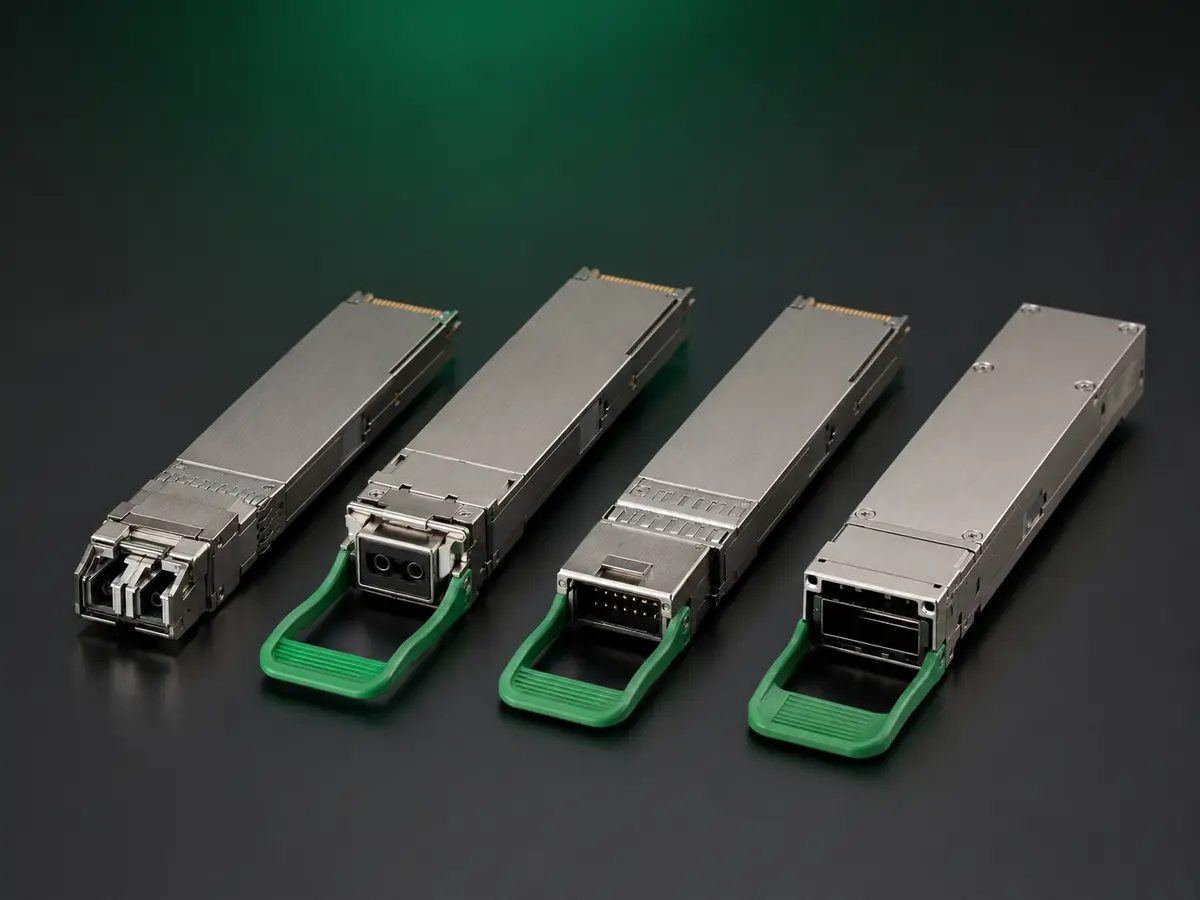
Choosing a 400G QSFP-DD module starts with the lane architecture, host capability and installed fibre—not with reach alone. A correct shortlist must align eight-lane electrical PAM4 operation with the optical interface, FEC, thermal envelope and operational route.
This buyer’s guide compares the main 400G options and shows what evidence should be requested before a sample or production order.
Understand the QSFP-DD platform
QSFP-DD expands the QSFP form factor to eight electrical lanes, commonly 8 × 50G PAM4 for 400G operation. Confirm the host port actually supports the required electrical mode.
Mechanical fit does not guarantee software, power or thermal compatibility.
Compare SR8 and parallel multimode
SR8 uses parallel multimode lanes and MPO connectivity for short data-centre links. Check fibre grade, polarity, connector gender and lane mapping.
Existing SR4 trunks cannot be assumed to support SR8 without reviewing the full cabling design.
Compare DR4 and parallel single-mode
DR4 uses four optical lanes over parallel single-mode fibre, normally through MPO. It suits short single-mode links and may support breakout applications when hosts allow it.
Confirm breakout mapping, FEC and interoperability for each endpoint.
Compare FR4 and LR4
FR4 and LR4 multiplex four wavelengths onto duplex single-mode fibre, typically with LC connectors. They reduce fibre count but add wavelength-management complexity.
Evaluate the actual loss budget, connector count and receiver margin rather than distance labels alone.
Consider coherent and extended-reach options
Longer metro and DCI applications may require coherent pluggables or specialised 400G optics. These introduce host, DSP, management and power requirements beyond ordinary client optics.
Keep coherent requirements on separate RFQ lines.
Confirm host coding and software
List vendor, chassis, line card, software and port mode. Ask for evidence on the same boundary, including recognition and diagnostics.
A compatible EEPROM string does not prove stable 400G traffic or recovery.
Plan FEC explicitly
400G PAM4 links depend heavily on the correct FEC relationship between host and module. Record the required mode and monitor corrected and uncorrected counters.
Do not approve a module that works only after undocumented changes.
Check power and thermal limits
Request maximum power consumption and case-temperature limits. Dense QSFP-DD cages can expose airflow and heat-sink weaknesses.
Validate representative adjacent-port loading, not a single open bench port.
Match diagnostics to operations
Confirm module-level and lane-level telemetry, alarm thresholds and host command output. Operations teams need meaningful readings for fault isolation.
Capture expected normal ranges during sample validation.
Build a controlled sample plan
Use multiple serials across the named hosts and fibre routes. Test identity, optical levels, traffic, FEC, alarms and recovery.
Samples should represent the production hardware, firmware and coding revision.
Compare landed cost
Include module price, cabling changes, spares, validation, warranty, freight and failure risk. A lower optic price may require a more expensive fibre architecture.
Request quantity bands and line-level lead times.
Release the exact configuration
The purchase order should freeze architecture, reach, connector, temperature, coding, firmware, labels and acceptance evidence.
MingApex can structure the technical RFQ and pilot around the named 400G host and route.
TECHNICAL RFQ
Turn your part number or project list into a reviewed quotation.
Share the available technical data. MingApex will structure the requirement, identify open compatibility questions and coordinate the supply review in China.
- Host platform or reference part number
- Speed, form factor and required reach
- Wavelength, fibre and connector
- Quantity, sample and delivery target
- OEM label or packaging requirement
- Destination country and Incoterm