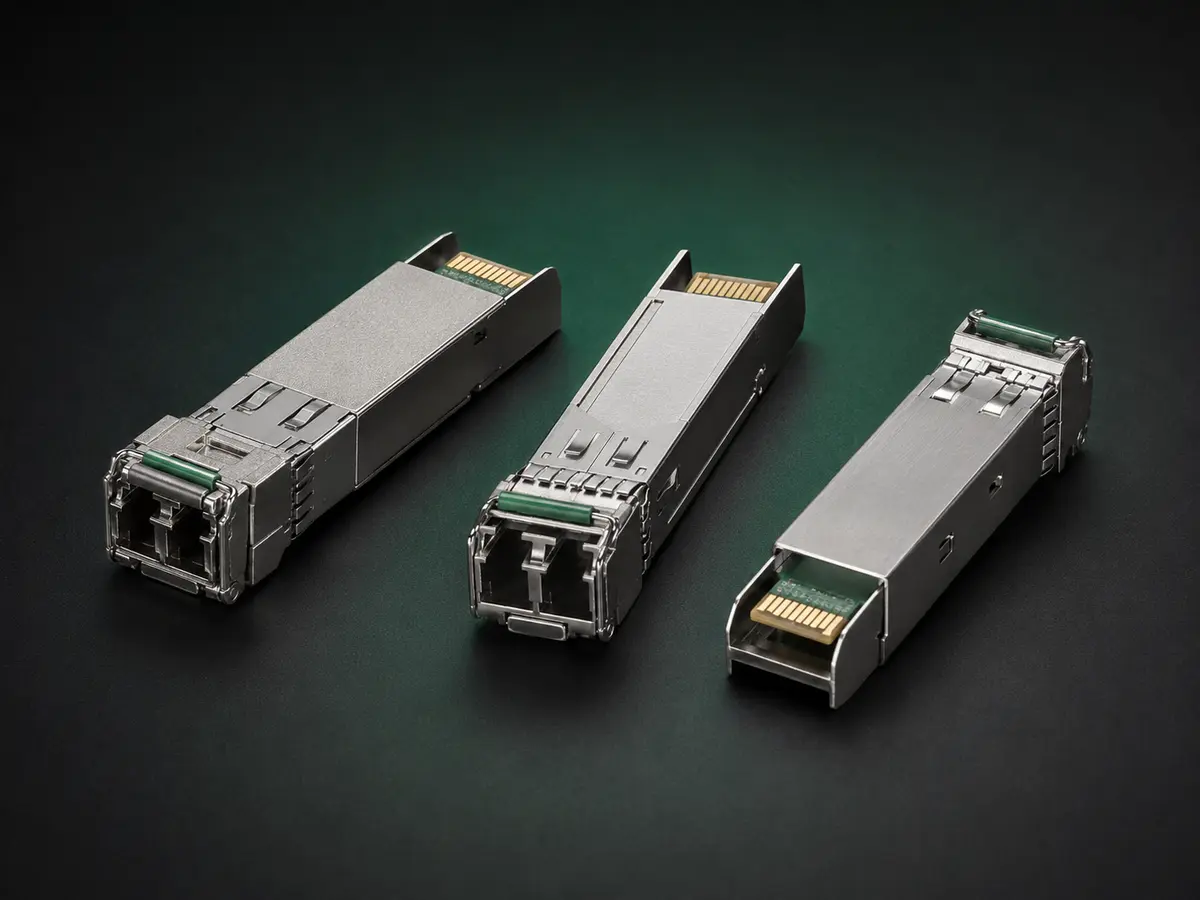
A 1G SFP purchase looks simple until two modules with the same speed fail to share the same fibre, wavelength, temperature range or host behaviour. The correct buying method starts with the installed link and ends with an acceptance record that can be reused for future orders. This guide gives procurement and network teams a practical specification, comparison and validation process rather than a list of generic product names.
Start with the installed link, not the catalogue
Record both endpoints before choosing an optic: manufacturer, exact chassis or switch model, line-card or port type, hardware revision and operating-system version. Add the current reference module if one exists. A phrase such as “Cisco compatible 1G SFP” is not specific enough because support rules can vary between platforms, releases and port groups. If a media converter sits at one end, document that device as carefully as the managed switch.
Measure the route that the signal will actually travel. Note fibre type, core count, connector format, patch panels, splices and any passive wavelength equipment. Keep physical route length separate from the required optical class. A nominal 10 km module does not automatically approve a link: connector loss, splice loss, fibre attenuation and an engineering margin all belong in the budget. Unknown values should become survey actions, not supplier assumptions.
- Endpoint A and endpoint B model/software
- Existing fibre: OM1–OM5 multimode or OS2 single-mode
- Connector and patching arrangement
- Measured route length and estimated total loss
- Indoor, cabinet or industrial temperature conditions
Choose the optical architecture that matches the route
1000BASE-SX is normally the short-reach multimode choice and uses an 850 nm optical interface with duplex LC connectivity. 1000BASE-LX/LH is associated with longer single-mode links and is also encountered in installations where launch conditions on multimode fibre need careful verification. EX- and ZX-class products extend reach but must be selected against an optical budget; on a very short route a high-power transmitter may require attenuation to avoid receiver overload.
A single-fibre route needs a complementary BiDi pair rather than two identical modules. One end transmits at one wavelength and receives at another; the peer reverses that relationship. CWDM modules add a defined channel plan and mux/demux loss. A 1000BASE-T copper SFP is a different electrical product with host-support, power and distance constraints. These families should never be collapsed into one line item merely because the enclosure says SFP.
| Requirement | Typical family to investigate | Critical confirmation |
|---|---|---|
| Short MMF link | 1000BASE-SX | Fibre grade and distance |
| Duplex SMF | LX/LH, EX or ZX class | Full optical budget |
| One strand | BiDi pair | Complementary wavelengths |
| Wavelength system | CWDM SFP | Channel and passive loss |
| Twisted-pair copper | 1000BASE-T SFP | Host support and power |
Treat compatibility as a host-specific testable claim
Mechanical fit and link light are weak evidence. The EEPROM identity and vendor fields may be checked by the host, while DOM/DDM data is used by operations teams to observe temperature, supply voltage, laser bias and optical power. Ask the supplier which coding profile will be written, which exact platform has been validated and whether warnings, unsupported-transceiver commands or monitoring limitations are expected.
Build a compatibility matrix when the project contains more than one switch family. Each row should identify host model, software, port, proposed module identity and sample result. Do not allow one successful test to become a universal claim. The SNIA SFF specifications describe the SFP form factor and management interface, but compliance with a form-factor document does not by itself prove that a specific network operating system will accept a particular coded module.
Specify temperature, traceability and repeat-order control
Use the actual ambient and enclosure conditions to select a temperature class. A controlled data room and a roadside cabinet impose different requirements even when both links are only one kilometre. If the project is exposed to heat, cold or poor ventilation, request the declared operating range and confirm it belongs to the quoted part—not to a different product in a general brochure.
Define the identity that must remain stable: product code, optical design, compatibility profile, label fields and packaging reference. Require notification before a component, firmware, memory map or coding change. Serial-number traceability is useful only if the seller can connect a serial number to the supplied configuration and production lot. For repeat orders, compare the new lot with the approved record instead of relying on the same marketing description.
Compare quotations on one controlled specification
Create a bid sheet with mandatory fields and prohibit silent substitutions. Each supplier should state wavelength, transmit and receive limits, connector, fibre, reach or budget, temperature class, coding profile, sample lead time, production lead time, MOQ, warranty route and any deviation. Separate product price from custom coding, label, packaging, inspection and freight so a low headline number cannot hide a different scope.
The lowest unit price is meaningful only after technical equivalence has been established. A generic commercial-temperature LX quote cannot be compared with an industrial BiDi pair, and a product described only as “10 km” cannot be compared with an optic supported by a complete budget. When alternatives are allowed, require the supplier to explain the consequence for fibre, host support, lead time and lifecycle.
Approve the sample and define lot acceptance
Test a representative sample in the exact host and software environment. Record module recognition, alarms, DOM values, stable link, negotiated speed and error counters during representative traffic. Use the intended fibre path or a controlled equivalent. For BiDi, wavelength or long-reach products, capture transmit and receive levels and compare them with the planned budget. Label photographs and command output should become part of the approval record.
Before production, identify which sample attributes are frozen and which changes require approval. Lot acceptance can include identity and label inspection, quantity, connector condition, selected DOM readings, host recognition on a sample plan, packaging and shipment records. The depth should reflect project risk, but evidence must refer to the ordered lot. Send MingApex the completed requirement through the technical RFQ page; availability and exact compatibility should be confirmed against that requirement rather than assumed from this guide.
Technical references
The SNIA SFF specification library includes the SFP form-factor and management-interface documents used as technical reference points. Always combine standards information with the host manufacturer support matrix and a project-specific sample test.
1g sfp transceivers buyers: technical requirement and quotation review
For 1G SFP Transceivers Buyer’s Guide, share the host model, software release, line rate, reach, fibre type, connector, temperature range and order quantity. MingApex will define the compatibility scope, sample validation, labelling and documented supply steps before quotation.
TECHNICAL RFQ
Turn your part number or project list into a reviewed quotation.
Share the available technical data. MingApex will structure the requirement, identify open compatibility questions and coordinate the supply review in China.
- Host platform or reference part number
- Speed, form factor and required reach
- Wavelength, fibre and connector
- Quantity, sample and delivery target
- OEM label or packaging requirement
- Destination country and Incoterm