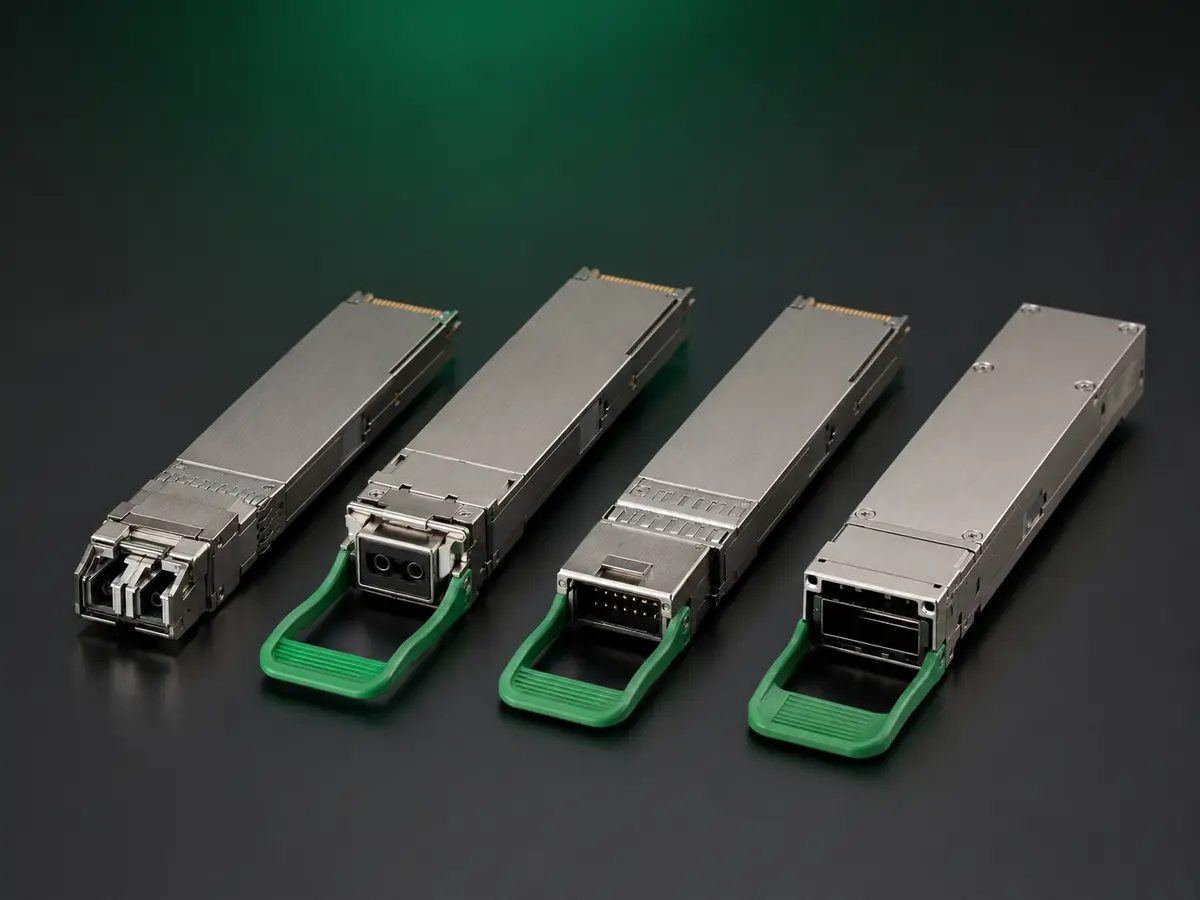
Buying a 100G QSFP28 transceiver is not a matter of matching speed and connector alone. A reliable purchase starts with the exact host platform, optical architecture, fibre plant, reach, FEC behaviour, environmental limits and evidence required for repeat orders. This guide gives procurement and network teams a practical method for comparing 100G options without treating unlike products as equivalents.
Define the link before requesting a quotation
Begin with the two endpoints. Record the switch, router or network-interface-card manufacturer, exact model, line-card or ASIC generation, hardware revision and operating-system release at both ends. State whether the port will run native 100G, a breakout mode, or both. A claim such as “100G compatible” is incomplete unless it names the tested platform and port configuration.
Document the physical route separately: total distance, fibre type, connector count, patch panels, cassettes, splices and any existing MPO/MTP polarity method. Include the planned operating temperature and whether the module will be used in a controlled data centre, an access cabinet or an industrial environment. These details determine which architecture is technically viable before price is discussed.
Choose the correct 100G optical architecture
QSFP28 is a form factor, not a single optical specification. Common choices include SR4 for parallel multimode fibre, CWDM4 and LR4 for duplex single-mode fibre, PSM4 for parallel single-mode fibre, and ER4-class solutions for longer routes. DAC and AOC assemblies can also be appropriate for short rack or row connections. Each option changes the connector system, usable reach, power, cabling work and maintenance process.
| Architecture | Typical interface | Common planning use | Buyer must verify |
|---|---|---|---|
| 100GBASE-SR4 | MPO/MTP, multimode | Short data-centre links | OM grade, polarity, connector gender, route loss and host FEC behaviour |
| 100G CWDM4 | Duplex LC, single-mode | Campus and data-centre interconnects | Actual reach class, link budget, FEC requirement and host support |
| 100GBASE-LR4 | Duplex LC, single-mode | Longer single-mode links | Standards profile, optical budget, temperature range and receiver limits |
| 100G PSM4 | MPO/MTP, single-mode | Parallel single-mode infrastructure | Fibre mapping, polarity, connector format and total installed-system cost |
| DAC or AOC | Fixed cable assembly | In-rack and short inter-rack links | Cable length, bend routing, host coding, power and serviceability |
The distance descriptions above are planning categories, not purchase guarantees. The exact standard, vendor specification and route budget must be checked for the proposed part number. Do not substitute one architecture for another simply because both carry 100G Ethernet.
Calculate an optical budget with operating reserve
For optical links, compare the transmitter minimum and receiver sensitivity with the measured or defensibly estimated route loss. The route calculation should include fibre attenuation, connectors, splices, patch panels, cassettes and a realistic allowance for ageing, contamination and future maintenance. Nominal reach alone does not prove that a specific installed route has adequate margin.
Also check receiver overload for short or high-power routes. A link can be inside the maximum reach and still be poorly designed if received power is too high. Record the assumptions used in the calculation so that a later lot, route change or replacement can be reviewed against the same boundary.
Verify host coding, FEC and diagnostics
Compatibility includes identification memory, vendor coding, alarm thresholds, digital diagnostics, FEC negotiation and stable operation under the intended software release. Ask the supplier to state the exact host and release covered by its compatibility claim. If multiple switch families are involved, use a matrix rather than a universal statement.
During sample validation, capture module recognition, reported part identity, temperature, voltage, transmit and receive power, alarms and error counters. Test cold boot, warm restart, port disable and enable, cable removal and restoration, and sustained traffic. If breakout will be used, validate every lane and the actual breakout command on the named host.
Control MPO/MTP details instead of assuming them
Parallel-optics projects require an explicit fibre map. State the connector format, gender, key orientation, polarity method, trunk and cassette arrangement, and whether the module interface is pinned. Identify the transmit and receive positions and label breakout legs. A correct module connected through the wrong polarity scheme produces a failed project that is not a transceiver defect.
Require the final quotation to repeat the agreed connector and fibre configuration. Photographs, cable labels and a route diagram are more useful than a generic “MPO compatible” statement. Receiving inspection should compare these details with the approved sample and packing list.
Build a sample-validation plan
A single link-up test is insufficient for a fleet decision. Select samples that cover more than one serial number and, where practical, more than one production lot. Use the real host platform, real fibre path or a controlled equivalent, and the intended software configuration. Record the test equipment, date, operator, module identity and raw results.
The validation plan should have explicit acceptance limits. These may include recognition, DOM stability, received-power margin, error counters, FEC state, traffic duration, restart recovery and temperature behaviour. Failed and borderline results must remain in the record; replacing them with a successful screenshot prevents useful root-cause analysis.
Evaluate the supplier behind the part number
Ask who controls coding, label generation, final inspection and corrective action. Determine whether the quotation is tied to a named production source and revision or whether components can change without notification. Confirm how approved identification, firmware profile and label artwork will be preserved for repeat orders.
For higher-risk deployments, request evidence appropriate to the order: a confirmed specification sheet, sample approval record, available test summary, serial or lot trace, label proof and packing documentation. Generic certificates or unrelated laboratory photographs do not demonstrate that the proposed configuration was validated.
Compare total delivered cost, not module price alone
The lowest unit price may require new trunks, cassettes, cleaning tools, host engineering or a larger spare pool. Compare the complete installed system: optics, cabling, adapters, qualification work, power, cooling, technician time, warranty handling and migration outage. Keep non-recurring engineering separate from recurring unit cost.
Request price tiers for the quantities you can realistically order, together with validity period, sample cost, production lead time and shipping terms. A price without a controlled specification is not comparable because a later supplier may quote a different optical class, temperature grade or coding scope under the same short description.
Plan MOQ, lead time and repeat orders
MOQ depends on the architecture, coding, label requirements, packaging and whether the item is drawn from an existing production profile. Ask the supplier to distinguish sample quantity, first production quantity and repeat-order quantity. Record which custom elements create the minimum.
Lead time should be separated into specification confirmation, sample preparation, buyer validation, production, final inspection and shipment. For repeat orders, reference the approved sample, coding profile, label revision and any controlled bill-of-material or source condition. Require notification before substitutions that could affect compatibility or reliability.
Use a quotation table that prevents hidden assumptions
| RFQ field | Required buyer input | Required supplier response |
|---|---|---|
| Host scope | Platform, hardware revision, OS and port mode | Exact compatibility scope and exclusions |
| Optical requirement | Architecture, wavelength class, reach and fibre | Proposed part number and specification revision |
| Physical interface | LC or MPO/MTP details, polarity and cabling | Confirmed connector configuration |
| Operating boundary | Temperature, route loss and FEC policy | Supported range and test conditions |
| Evidence | Sample and document requirements | Available validation and trace records |
| Commercial | Sample quantity and forecast volumes | MOQ, tiers, lead time, warranty and Incoterms |
Unknown fields should be marked as open questions. They should not be silently filled with a convenient supplier default. Closing these questions before production is less expensive than diagnosing an incompatible fleet after delivery.
Receiving inspection for production lots
Receiving inspection should verify quantity, outer packaging, labels, part identity, serial or lot references and visible connector condition. Select a risk-based sample for recognition and functional checks against the approved host profile. The inspection record must link each tested unit to the purchase order and approved configuration.
If a lot differs from the approved sample, stop release until the change is explained and assessed. A working link on one port does not automatically approve a changed coding profile, optical component or firmware revision for every platform in the deployment.
A practical 100G QSFP28 buying decision
A defensible award decision has three layers. First, the proposed architecture fits the actual fibre route and operating environment. Second, compatibility is demonstrated on the named host, port mode and software release. Third, the supplier can preserve the approved configuration and provide traceable repeat orders. Price comparison becomes meaningful only after these conditions are normalised.
For a structured review, send the host model, software release, required reach, fibre and connector type, temperature range, quantity and target delivery date through the MingApex technical RFQ. MingApex can then coordinate specification confirmation, compatibility scope, sample validation, labelling and documented supply steps before a production quotation is accepted.
Buyer checklist before approval
- Both endpoint platforms and software releases are recorded.
- The optical architecture and fibre route are explicitly defined.
- Connector, polarity and breakout requirements are documented.
- Link budget includes route loss and operating reserve.
- FEC, diagnostics and recovery behaviour are validated.
- The approved sample is tied to coding, label and revision.
- MOQ, lead time, warranty and change-control terms are written.
- Production receiving inspection has measurable acceptance criteria.
TECHNICAL RFQ
Turn your part number or project list into a reviewed quotation.
Share the available technical data. MingApex will structure the requirement, identify open compatibility questions and coordinate the supply review in China.
- Host platform or reference part number
- Speed, form factor and required reach
- Wavelength, fibre and connector
- Quantity, sample and delivery target
- OEM label or packaging requirement
- Destination country and Incoterm