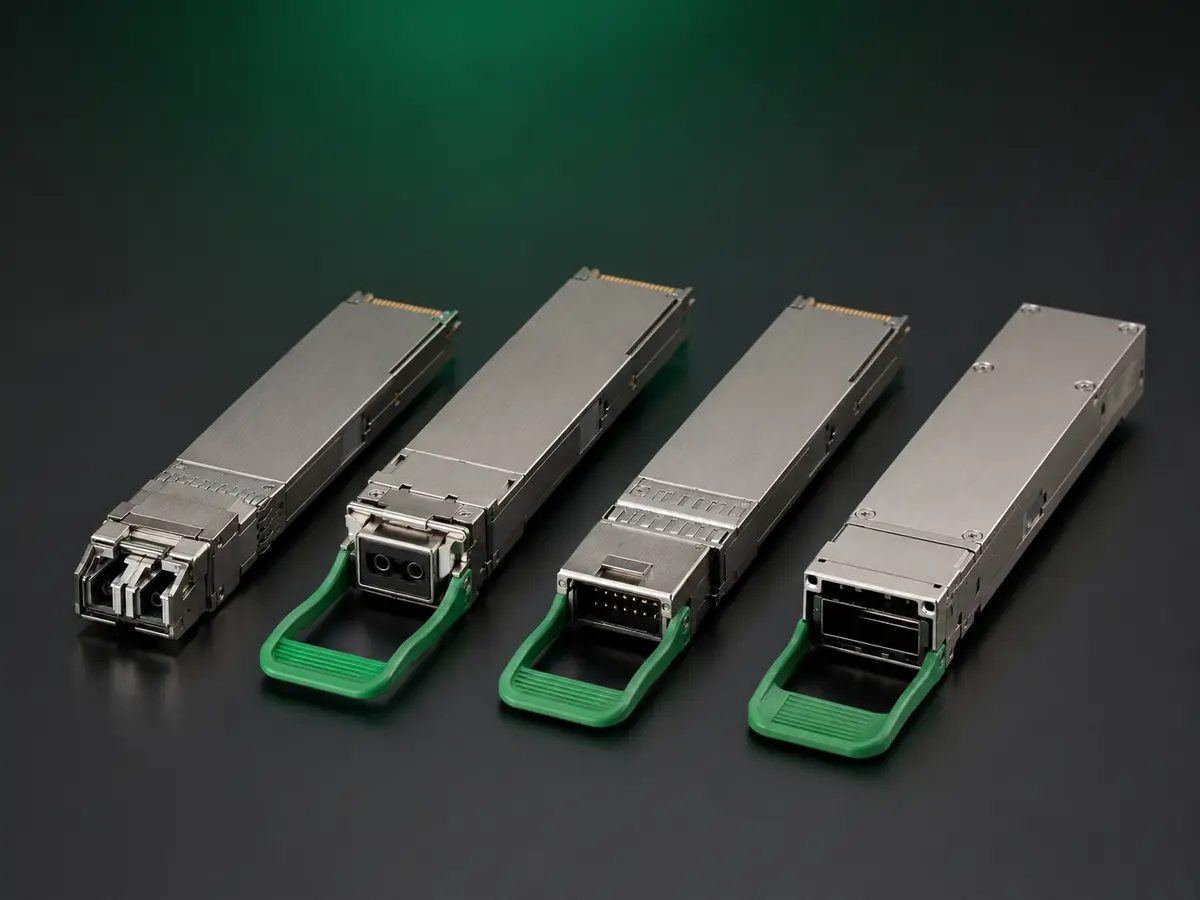
A 200G QSFP56 purchase should begin with the host’s four-lane 50G PAM4 capability, the required optical architecture and the installed fibre route. A module that fits a QSFP cage may still be incompatible electrically, thermally or in software.
This guide compares the main 200G choices and defines the evidence needed before production release.
Understand QSFP56 signalling
QSFP56 commonly carries four electrical lanes at 50G PAM4 to produce 200G.
Confirm the host supports this lane mode rather than older NRZ-only operation.
Compare SR4
200G SR4 uses parallel multimode lanes for short data-centre links.
Check MPO polarity, fibre grade, connector gender and lane mapping.
Compare DR4
DR4 uses parallel single-mode optics, normally over MPO, and can support selected breakout designs.
Validate breakout mapping and endpoints.
Compare FR4
FR4 multiplexes wavelengths onto duplex single-mode fibre, typically with LC.
It conserves fibres but requires a controlled loss budget.
Compare LR4
LR4 extends duplex single-mode reach with tighter optical requirements.
Use measured route loss rather than nominal distance alone.
Review breakout requirements
Some 200G hosts support breakout to lower-speed endpoints.
Confirm electrical mapping, cables, FEC and peer support before ordering.
Specify host compatibility
List chassis, line card, software and port mode.
Request evidence on the same boundary.
Plan FEC
PAM4 links depend on correct FEC operation.
Capture corrected and uncorrected counters under sustained traffic.
Check diagnostics
Verify temperature, voltage, bias and lane optical powers.
Confirm host command mapping is useful to operations.
Review power and thermals
Ask for maximum power and case-temperature limits.
Test representative adjacent-port loading and airflow.
Build a sample plan
Use several serials across named hosts and routes.
Test identity, optics, traffic, FEC and recovery.
Compare total cost
Add cabling, validation, spares, warranty, freight and failure exposure.
MingApex can structure the RFQ around the exact 200G configuration.
Control production release
Freeze hardware, firmware, coding, labels and acceptance limits.
Require change notification for repeat orders.
Plan interoperability
Where different suppliers or form factors meet, define standards claims, FEC and host boundaries explicitly. Use a controlled mixed-vendor test rather than assuming equal labels guarantee interoperability.
Keep the peer module and firmware in the approval record.
Prepare repeat supply
Agree part numbers, hardware and firmware change rules, serial traceability and retained results before the first production order.
Approval should transfer only to the named configuration.
TECHNICAL RFQ
Turn your part number or project list into a reviewed quotation.
Share the available technical data. MingApex will structure the requirement, identify open compatibility questions and coordinate the supply review in China.
- Host platform or reference part number
- Speed, form factor and required reach
- Wavelength, fibre and connector
- Quantity, sample and delivery target
- OEM label or packaging requirement
- Destination country and Incoterm