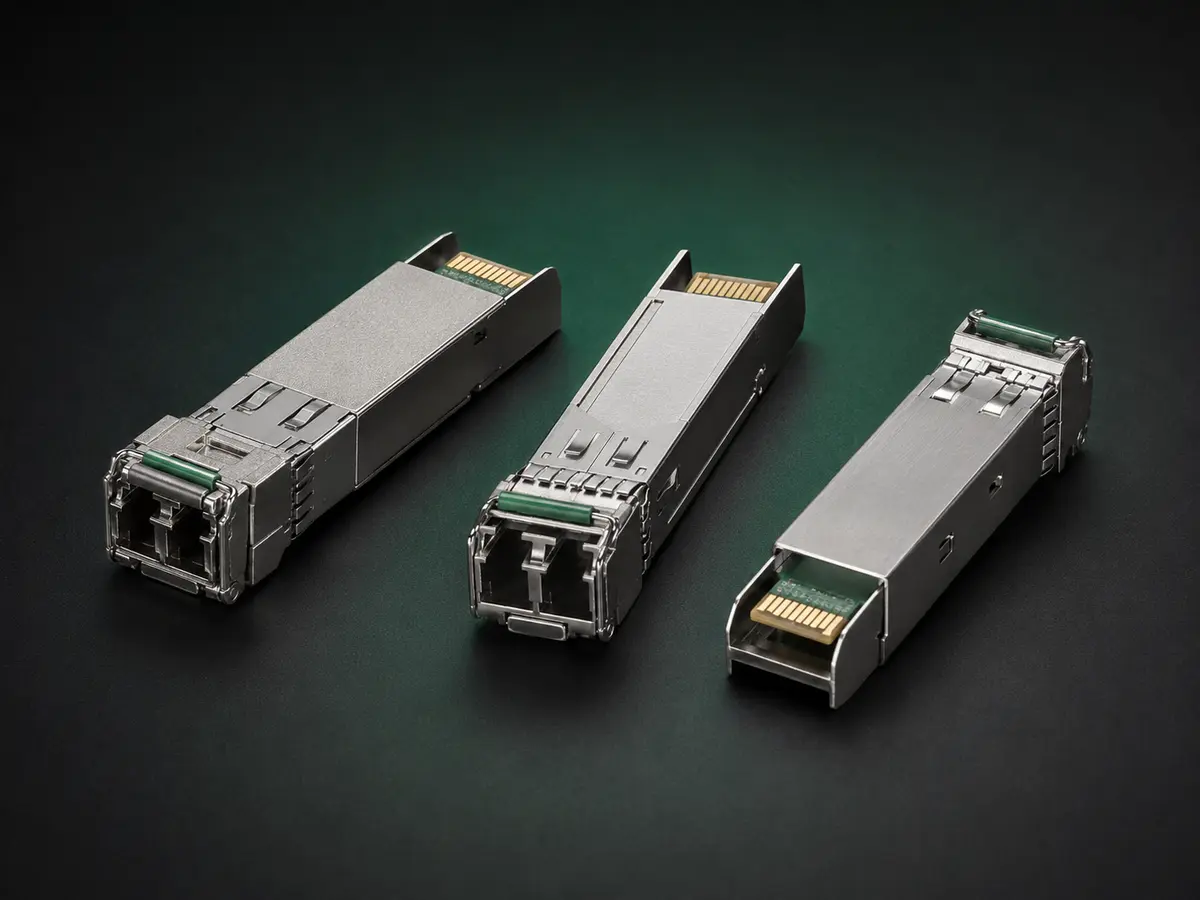
Incoming inspection for 1G SFP modules should confirm order identity, construction, coding, optical performance and traceability before stock is released. The checklist must distinguish a shipment-level screening activity from host qualification and destructive reliability testing. Its purpose is to detect meaningful lot drift without pretending that a small sample proves every unit.
Reconcile shipment identity before opening stock
Decision baseline: For 1G SFP incoming quality inspection, define purchase-order revision, buyer SKU, supplier part, quantity, lot, serial range, manufacturing date, coding target, labels and packaging level. Write the requirement at the same level of detail used by engineering, purchasing, receiving and operations. An abbreviation that is convenient in a catalogue is not a controlled specification. Unknown fields must stay visible until an authorised person closes them; they must not be replaced silently by a supplier default.
Evidence package: Retain packing list, carton and unit labels, serial export, approved artwork, supplier declaration, seal condition and discrepancy photographs. Raw values, methods, dates and product identities matter as much as the final pass statement. Every reading, drawing or document should connect to the applicable buyer line, sample, route, host, lot or serial so another reviewer can reproduce the decision without relying on private messages.
Failure to avoid: A recurring failure is merging mixed revisions into one receiving lot because the external description and connector look alike. This shortcut can create a low price or an apparently working link while moving uncertainty into deployment, warranty or repeat ordering. Record the possible service and commercial consequence before accepting a deviation, and do not generalise one successful test beyond its documented boundary.
Control action: If the baseline and evidence do not agree, segregate unexplained identities, count every affected unit and obtain a written product mapping before sampling. Preserve the original state, change one meaningful variable at a time and require every supplier clarification to reference the same controlled product. An accepted exception needs an owner, scope, expiry and revalidation trigger; editing the requirement after a failure is not validation.
Release condition: Close this gate only when the physical shipment and electronic records describe one controlled and countable population. The approval record should state what was tested, what was inferred from documents and what still depends on buyer validation. Passing this gate authorises the named configuration only; it does not prove universal compatibility, unlimited optical margin or equivalence of future revisions.
Inspect workmanship and mechanical condition
Decision baseline: For 1G SFP incoming quality inspection, define housing finish, latch movement, connector geometry, contamination, label adhesion, PCB seating, solder evidence, damage and packaging protection.
Evidence package: Retain magnified endface images, dimensional checks, defect catalogue, inspection lighting, sample serials, severity classification and retained examples.
Failure to avoid: A recurring failure is cleaning visible contamination and passing the unit without recording its cause or checking neighbouring packages.
Control action: If the baseline and evidence do not agree, classify defects consistently, expand sampling after clustered findings and quarantine damage that can affect insertion or optical coupling.
Release condition: Close this gate only when critical defects are absent and accepted cosmetic limits match the signed visual standard.
Verify EEPROM, coding and diagnostics
Decision baseline: For 1G SFP incoming quality inspection, define identifier fields, vendor and buyer identity, part and serial format, wavelength, reach, checksums, DOM calibration, alarms, thresholds and write protection.
Evidence package: Retain complete memory dumps, reader version, expected-field map, host command output, alarm stimulation, coding revision and exception list.
Failure to avoid: A recurring failure is checking only the displayed vendor name while incorrect calibration, threshold or checksum fields remain hidden.
Control action: If the baseline and evidence do not agree, compare every required byte or interpreted field with the approved map and investigate any systematic offset by serial group.
Release condition: Close this gate only when the sampled units expose the approved identity and diagnostics without unexplained field variation.
Measure optical and functional performance
Decision baseline: For 1G SFP incoming quality inspection, define transmitter power, receiver response, wavelength, extinction or applicable modulation metrics, DOM accuracy, link recognition, traffic, errors and restart behaviour.
Evidence package: Retain calibrated equipment records, reference attenuator and fibre, raw readings, uncertainty, ambient condition, host details, duration and serial mapping.
Failure to avoid: A recurring failure is using one successful short link as a substitute for quantitative limits and receiver-boundary testing.
Control action: If the baseline and evidence do not agree, measure agreed parameters with traceable methods, retest outliers and separate equipment uncertainty from product variation.
Release condition: Close this gate only when all critical measurements and functional checks meet the order-specific limits for the sampled population.
Apply sampling rules and document lot disposition
Decision baseline: For 1G SFP incoming quality inspection, define population definition, random selection, normal and tightened plans, defect classes, acceptance numbers, escalation, rework, retest and release authority.
Evidence package: Retain selection record, complete result table, defect photographs, nonconformance numbers, supplier response, corrective action, retest population and signed decision.
Failure to avoid: A recurring failure is replacing failed samples until enough passing units are found or releasing unaffected cartons without proving segregation.
Control action: If the baseline and evidence do not agree, follow the predetermined decision rule, preserve every failure and define the exact population covered by corrective action.
Release condition: Close this gate only when authorised reviewers can trace why the named lot was accepted, rejected or conditionally held.
RFQ, commercial scope and final approval
A defensible receiving decision links the purchase order, approved reference, sample plan, measured results, exceptions and released serial population in one record.
Send the exact configuration, hosts, route or assembly, quantities, label requirements and requested evidence through the MingApex technical RFQ. Put assumptions and deviations in a separate register so competing quotations describe comparable deliverables. MingApex is the commercial brand; use Ming Hong Xin Fu Trading Co., Ltd. only where a formal legal company name is required.
The final proposal must not claim trademark affiliation or universal host support without project evidence. Availability, suitability and production equivalence remain order-specific. The technical record should focus on product identity, validation, quality evidence and the commercial delivery obligation.
1g sfp transceivers quality: technical requirement and quotation review
For 1G SFP Transceivers Quality Inspection Checklist, share the host model, software release, line rate, reach, fibre type, connector, temperature range and order quantity. MingApex will define the compatibility scope, sample validation, labelling and documented supply steps before quotation.
TECHNICAL RFQ
Turn your part number or project list into a reviewed quotation.
Share the available technical data. MingApex will structure the requirement, identify open compatibility questions and coordinate the supply review in China.
- Host platform or reference part number
- Speed, form factor and required reach
- Wavelength, fibre and connector
- Quantity, sample and delivery target
- OEM label or packaging requirement
- Destination country and Incoterm